

Last Updated: February 10, 2026

Homeless Services Department FY 2027 Budget FAQ

This FAQ explains the requested budget for the Multnomah County Homeless Services Department (HSD) for the coming year.

Please keep in mind that any budget proposals are not final. We are at the beginning of a transparent, multi-step process that includes extensive opportunities for public engagement. Between now and June, when the Board is set to adopt a final budget for FY 2027, these recommendations remain open to adjustment.

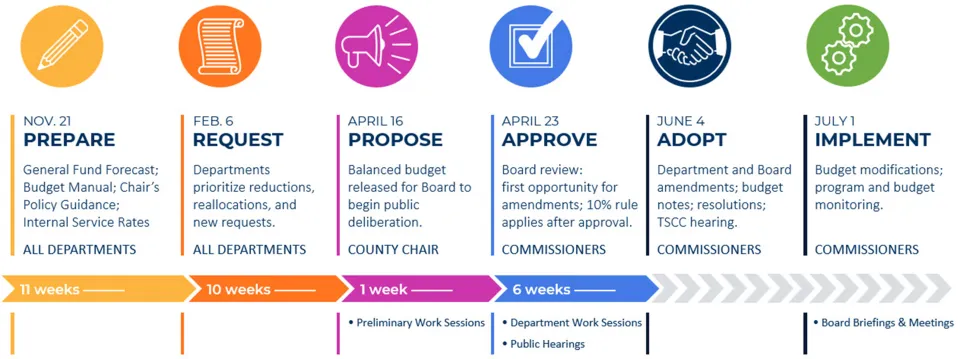
View Budget Process Timeline

Our FY 2027 Transmittal Letter and Recommended Budget Details are now online. You can review the full set of documents here

The Deficit: Understanding the Numbers

Please find associated FAQs below.

Q: What is the size of the HSD budget deficit?

The budget deficit facing the Homeless Services Department (HSD) isn’t the result of a single issue. Instead, it is driven by several major factors—including the scheduled end of one-time-only (OTO) funding and the rising cost of providing services

The Initial Deficit ($87M): On paper, we are looking at an $87 million difference between what we spent last year and what is needed for the next fiscal year.

Subtracting One-Time Commitments (-$31M): We don’t have to cut the full $87M because $31 million was for “One-Time-Only” commitments. These were temporary efforts that were already scheduled to end this year.

The Base Operating Gap ($56M): Once we remove those finished projects, the actual gap for our ongoing, everyday services is $56 million.

Accounting for Rising Costs (+$12M): To keep up most current services, we have to account for $12 million in new costs due to inflation and higher service rates.

The Final Structural Shortfall ($68M): This leaves us with an actual operational gap of $68 million that we must solve for to keep our core homelessness response system stable.

Q: Why does HSD have a budget deficit?

The shortfall comes down to two main factors: we have less revenue coming in, and the temporary funds that the Board of Commissioners approved to support our recent growth are now exhausted.

  • One Time Only Funding: HSD previously used one-time carryover funds to both expand and maintain services during the first years of the Metro Supportive Housing Services (SHS) Measure. Those temporary funds are now exhausted.
  • External Reductions: Decreases in expected federal and state funding, along with a redirection of City of Portland funding, has compounded the gap.

Service Impact & Priorities

Q: How will budget reductions impact current services?

Even after any reductions for FY 2027, our region’s homelessness services continuum will still be larger — serving more people — than it was before its expansion during and after the COVID-19 pandemic.

The Homeless Services Department will continue to serve thousands of people in our community each year with shelter, housing, street outreach, and other essential services. In the fiscal year ending in June 2025, over 6,000 people left homelessness for housing across the Multnomah County service continuum. And more than 10,208 people spent at least one night in a shelter bed during that same time period. Even more people are served with street outreach, day centers, employment supports, behavioral health and substance use supports, and more.

But a reduction of this scale will have tangible impacts. It won’t be possible to do more with less, so HSD is focused on sustaining a balanced system of “complementary services.” To guide these difficult choices, we are centering three policy goals:

  1. Keeping people housed: Avoiding cuts that would put people who’ve previously experienced homelessness back on the street.
  2. Effective Housing Placements: Maintaining programs where 84% of participants remain housed after two years.
  3. Maximizing Shelter Effectiveness: Prioritizing shelters that act as direct pathways to permanent housing.

Process & Engagement

Please find associated FAQs below.

Q: How were these funding priorities determined?

These priorities were not established in a vacuum. Since October, HSD led a comprehensive engagement process with leaders and frontline staff from our network of providers across Multnomah County. By collaborating with specialists in shelter, housing, and wraparound services, we ensured our strategy is rooted in the reality of those doing the work on the front lines.

Q: What is the timeline for final decisions?

  • Feb. 13: HSD’s detailed budget proposal will be published on the County Budget Office website at www.multco.us/budget
  • April 16: The County Chair will propose her executive budget.
  • June 4: The Board of Commissioners will adopt the final budget.

Q: How can I share my opinion?

Constituents can learn about the budget process, view the full timeline, and find opportunities to make their voices heard in-person and online at this link.

Q: Where can I find additional information on the FY 2027 HSD budget?

Additional detail on the HSD budget constraints and history of funding can be found in our presentation to the Board of County Commissioners on February 3, 2026.

Regional Coordination & Effectiveness

Please find associated FAQs below.

Q: Is the County spending homeless services money effectively?

Yes. Recent data shows Multnomah County is “getting more bang for its buck” compared to regional neighbors. As reported by Willamette Week

“Multnomah County has placed 4,740 households into permanent housing, or 52.59% of the total 9,010 across the three counties. By that measure, Multnomah County did more with less, exceeding its share of funding by more than 7 percentage points. In terms of households kept from losing their homes through measures like rent assistance, Multnomah County kept 12,656, or 66.14%, housed, beating the bogey by about 21 percentage points.”

And as the Oregonian recently reported on the Supportive Housing Services measure:

“Even as the homeless count has ticked steadily upward for five years running, the three counties have collectively met, or are on track to meet this year, the initial 10-year performance goals set for them in the measure. All three counties have added shelter beds and hired more street outreach staff. They’ve upgraded data systems, raised wages for frontline workers and improved communication channels with other public service agencies.

“But none of that work has stopped the flow of people into homelessness, which increased by 61% in the tri-county area between 2023 and 2025. As of December, approximately 18,000 people were homeless in the Portland metro region. Nor has it reduced the complexity of ending someone’s homelessness, a task as unique to each person as a fingerprint.”

Q: Are the County and the City of Portland still working together?

Yes. Both governments coordinate through the Homelessness Response System, with City and County leaders serving together on the body’s Steering and Oversight Committee. Its guiding document, the Homelessness Response Action Plan, was recently updated and approved by both Multnomah County and the City of Portland. We continue to work closely to ensure our services complement each other and avoid duplication.